Visit the Rodin Museum in Paris
What will it be like to step through the entrance of the Rodin Museum in Paris? It means entering a place where matter appears to breathe, and where one of the world’s most iconic sculptures, The Thinker, immediately becomes part of the visitor’s imagination. Known internationally as one of Rodin’s greatest masterpieces, this work is far more than a famous piece of art: it is a symbol of human reflection, creativity, and inner struggle. The museum is not merely a museum or a memorial house, but a garden of ideas, an atelier in which time seems to stand still.
The museum complex, housed in the Hôtel Biron in the elegant heart of the seventh arrondissement, welcomes visitors with a refined and almost shy lightness, as though it wanted to let the works speak for themselves. The building, dating back to the eighteenth century, is surrounded by a garden designed for reflection. As soon as you enter the garden, you are absorbed into a magical stillness. A soft silence, slightly interrupted by the rustling of the trees and the measured steps of visitors, prepares the eye for the encounter with The Thinker statue.
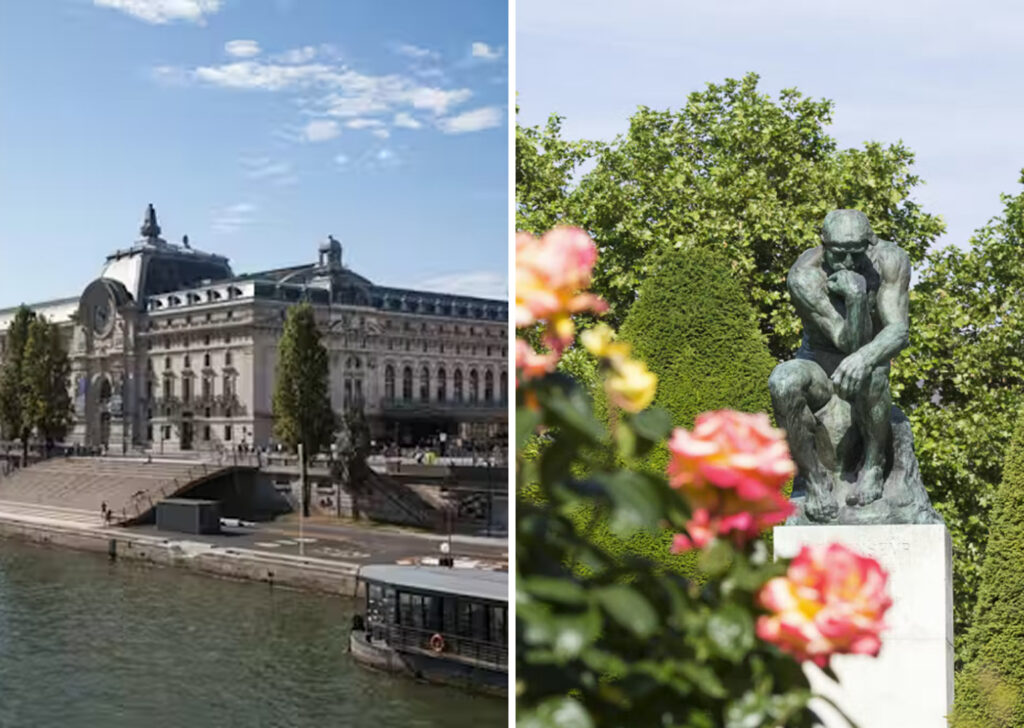
In the distance, the powerful seated figure appears on a strong pedestal, dominating the main walkway and drawing visitors toward it. Seeing The Thinker sculpture in person is another matter altogether. You can observe the curve of the shoulders, the tension of the hands, and the serious yet anxious expression of the face. It has an unexpected physical reality. Each muscle seems to contain an idea; the bronze appears shaped by an indefinable inner force, full of questions, anxieties, and visions.
Created by the French sculptor Auguste Rodin, the work originally formed part of a much larger project. Today, however, it has become an independent icon, admired around the world. Standing before Rodin’s The Thinker, visitors quickly understand why it remains one of the most celebrated sculptures in art history. The figure embodies concentration and introspection, transforming a simple seated pose into a universal representation of thought itself.
The visit continues with The Gates of Hell, a monumental work on which Rodin spent many years, developing different forms, variations, and experiments. Figures appear, fall, shift, and seem to melt into the sinuous surface. It was for this ambitious project that The Thinker was originally conceived, representing a contemplative figure overlooking the dramatic scenes below. Understanding this connection adds another layer of meaning to the experience of seeing the sculpture in the museum gardens.
The museum becomes a bodily experience: a monumental work, an intricate combination of details, and an open conversation with natural light. It creates a presence that passes through the visitor and cannot simply be observed from a distance. The rooms of the Hôtel Biron have an almost domestic and familiar atmosphere. The spaces are bright and filled with a silence that is not oppressive, but rather invites visitors to experience the galleries slowly.
The creaking of the parquet floor seems to revive the steps of those who lived and worked there many years ago: artists, curators, and visitors from different times. Plaster sculptures, bronze and marble works, drawings, photographs, sketches, and small studies allow visitors to trace the artist’s creative process. Throughout the galleries, Rodin’s artistic genius and countless other masterpieces emerge through studies and preparatory models that reveal the sculptor’s relentless pursuit of expression.
The gallery devoted to Balzac is one of the most evocative rooms in the building. The sculpture representing him is considered one of Rodin’s most radical works. It does not simply reproduce the writer’s physical appearance, but condenses his intellectual essence. The figure is wrapped in a cloak that seems animated by Balzac’s own creative force.
Another room displays famous sculptural groups such as The Kiss, a manifestation of passion and surrender. The marble is almost like skin: the softness of the surfaces, the delicacy of the curves, and the naturalness of the gesture create the impression of a balanced and suspended life. The two lovers are locked in an eternal embrace, a physical contact that is both intimate and captivating.
Alongside the major works, plaster sketches and fragments of hands, heads, and feet appear like three-dimensional notes. Rodin’s working method becomes clearly visible, as does his desire to understand the human body in every possible aspect. Rodin experiments, makes mistakes, and begins again. It feels like entering the backstage of his masterpieces. These studies also help visitors appreciate the extraordinary craftsmanship behind The Thinker sculpture, whose apparent simplicity conceals years of experimentation and artistic refinement.
There is also a section dedicated to Camille Claudel, an extraordinarily talented sculptor, as well as Rodin’s collaborator, muse, and companion. She emerges as a powerful creative figure, whose sensitivity appears vividly in her works. The dialogue between the works of Rodin and Claudel becomes a dialogue of influences, tensions, and inspirations.
Outside, the gardens extend with geometrically shaped hedges, rose gardens, and reflecting pools. The sculptures appear to change their expression with the light. The Burghers of Calais, with their features of despair and courage, become even more intense in the open air. And The Thinker remains one of the central presences of the visit: a silent figure that seems to gather the spirit of the entire museum, suspended between thought, effort, and human mystery.
Whether visitors know it simply as The Thinker or as Rodin’s most iconic sculpture, the encounter leaves a lasting impression. The work possesses a rare ability to speak across cultures and generations, inviting everyone to pause and reflect on the complexity of the human condition.
What to See at the Rodin Museum
How can the Rodin Museum be defined? As a Parisian world suspended between bronze, natural light, and marble. Here, emotions seem to take shape under the enchanted touch of a sculptor, and one of Rodin’s most iconic masterpieces, The Thinker, immediately becomes a symbol of the entire visit. Once you step into the Hôtel Biron, the eighteenth-century mansion that houses the museum, you have the feeling of entering a place where art is not only contemplated, but almost physically experienced.
The first great experience in the museum is the garden, a park that embraces the main building and absolutely deserves to be explored. Paths lined with rose gardens, centuries-old trees, and shifting plays of light guide visitors through a landscape where sculptures emerge naturally from their surroundings. It is here that you encounter one of Rodin’s most famous works, The Thinker. Seeing it in person is a unique emotion: the power of the figure evokes balance, concentration, and deep introspection all at once. Seated in silence, yet filled with inner tension, The Thinker becomes a timeless image of contemplation and the mystery of existence.
If you continue along the garden path, you come across another masterpiece, The Gates of Hell. Rodin created it drawing inspiration from Dante’s Divine Comedy. Every detail is carefully crafted and deeply meaningful, as each figure seems to tell a fragment of life or embody an intense emotion. Grasping hands, slipping feet, and tormented faces emerge from the bronze surface, creating a dramatic and unforgettable vision.
The moment visitors step inside the Hôtel Biron, the atmosphere changes. The rooms, with their elegant classical style, offer a refined contrast to the raw force of the sculptures. One of the most moving galleries is dedicated to The Kiss, one of Rodin’s most tender and, at the same time, most seductive creations. If you were to bring your hand close to the stone, you might almost imagine the marble breathing and shifting. Soft bodies, a spontaneous embrace, and desire suspended in a poetic moment create one of the most memorable experiences of the visit.
Another key moment is the encounter with The Burghers of Calais, a sculptural group overflowing with drama and dignity. The figures are wrapped in heavy garments, their lives marked by tragedy, and they seem to move within a moment frozen in time. It is an intimate struggle between fear and sacrifice. Rodin’s realism is so powerful because it does not seek idealized beauty, but instead expresses authentic human strength and vulnerability.
The museum also offers the opportunity to discover the artist’s creative process through sketches, plaster models, studies, preliminary works, and unfinished pieces. Together, these reveal Rodin’s human side, not only his visionary artistic genius. His work resembles a river in constant motion, an endless flow of forms, experiments, variations, and discoveries. Inside the Hôtel Biron, there is also a special section dedicated to Camille Claudel, Rodin’s pupil, muse, companion, and an extraordinary artist in her own right. Her works are intense and vibrant, engaging in a powerful dialogue with those of Rodin. Claudel’s sculptures enrich the Rodin Museum with a distinct voice: a feminine sensitivity that combines delicacy and torment with remarkable strength.
The visit ends where it began: in the garden. After exploring the indoor galleries, returning outside allows visitors to see the sculptures with fresh eyes. The Thinker, encountered once again either in sight or in memory, seems even more powerful after discovering the complexity of Rodin’s artistic universe. A bench invites visitors to pause, observe the changing light on the bronze surfaces, and listen to the silence broken only by the rustling leaves. Here, art and nature come together in perfect harmony, creating a space for peace and reflection.
The Rodin Museum offers the chance to admire an extraordinary sculptural heritage, but it is also an emotional journey through beauty, strength, and human fragility. It is a place that encourages visitors to slow down rather than simply look, leaving a lasting impression on everyone who experiences it. So what are you waiting for? Visit the Rodin Museum and discover a place where art feels like a waking dream.
Passes and Bundles
Useful info
Opening hours
Tuesday–Sunday 10:00–18:30 (last entry 17:45). Closed Monday, plus Jan 1, May 1, Dec 25. Seasonal note: for safety the sculpture garden closes at 17:00 (evacuation from 16:45) until Jan 4, 2026. Shops typically 10:00–18:00. Always peek at the day’s schedule.
Location
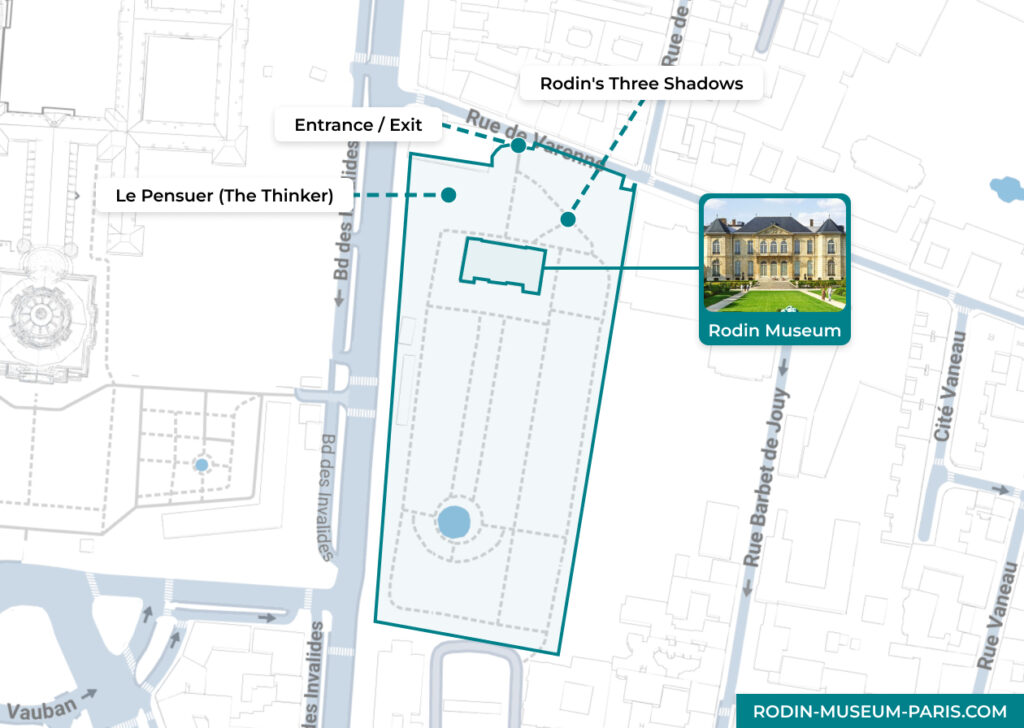
The museum lives in the elegant Hôtel Biron with a leafy sculpture garden: 77 rue de Varenne, 75007 Paris—a short hop from Invalides and the Eiffel Tower. It’s a tranquil pocket right in the 7th arrondissement.
How to get there
Easiest links: Metro 13 (Varenne), Metro 8/13 (Invalides), RER C (Invalides). Buses 69, 82, 87, 92 stop nearby. Vélib’ bikes and paid parking sit along Boulevard des Invalides. Save the address in your maps app for a smooth arrival.
Best time to visit
Come right at opening or late afternoon for serene rooms and quieter garden paths. Spring and autumn bring softer light; winter feels wonderfully calm. If you’re museum-hopping, pair Rodin’s garden stroll with nearby Invalides or a late Orsay visit after 16:00.
Duration of the visit
Allow around 2–3 hours for your visit, giving yourself plenty of time to explore the rooms of the Hôtel Biron and stroll through the sculpture garden, where you can admire masterpieces such as The Thinker and The Gates of Hell. Take a few extra moments to snap some photos, enjoy a break at the café, or relax on a bench—the Rodin Museum is best experienced at a leisurely pace.
Accessibility
Good step-free access: ramps, wheelchairs available at the cloakroom, and accessible toilets with push-button doors. The temporary exhibition, garden, café, and auditorium are accessible; staff can help with routes and assistance. Service animals welcome.
Opening hours
Tuesday–Sunday 10:00–18:30 (last entry 17:45). Closed Monday, plus Jan 1, May 1, Dec 25. Seasonal note: for safety the sculpture garden closes at 17:00 (evacuation from 16:45) until Jan 4, 2026. Shops typically 10:00–18:00. Always peek at the day’s schedule.
Location
The museum lives in the elegant Hôtel Biron with a leafy sculpture garden: 77 rue de Varenne, 75007 Paris—a short hop from Invalides and the Eiffel Tower. It’s a tranquil pocket right in the 7th arrondissement.
How to get there
Easiest links: Metro 13 (Varenne), Metro 8/13 (Invalides), RER C (Invalides). Buses 69, 82, 87, 92 stop nearby. Vélib’ bikes and paid parking sit along Boulevard des Invalides. Save the address in your maps app for a smooth arrival.
Best time to visit
Come right at opening or late afternoon for serene rooms and quieter garden paths. Spring and autumn bring softer light; winter feels wonderfully calm. If you’re museum-hopping, pair Rodin’s garden stroll with nearby Invalides or a late Orsay visit after 16:00.
Duration of the visit
Allow around 2–3 hours for your visit, giving yourself plenty of time to explore the rooms of the Hôtel Biron and stroll through the sculpture garden, where you can admire masterpieces such as The Thinker and The Gates of Hell. Take a few extra moments to snap some photos, enjoy a break at the café, or relax on a bench—the Rodin Museum is best experienced at a leisurely pace.
Accessibility
Good step-free access: ramps, wheelchairs available at the cloakroom, and accessible toilets with push-button doors. The temporary exhibition, garden, café, and auditorium are accessible; staff can help with routes and assistance. Service animals welcome.
Rodin Museum Map